

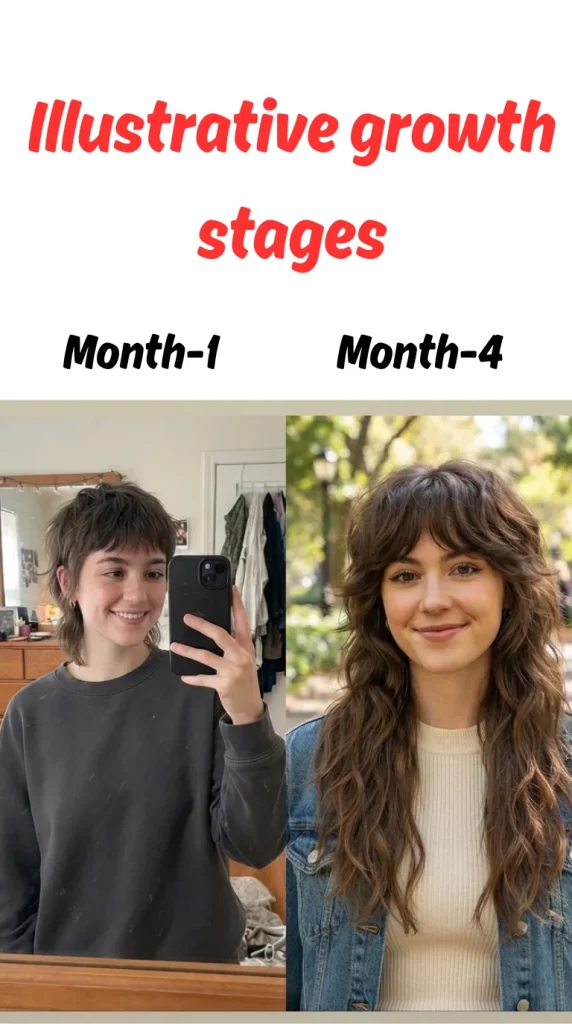
If you’ve searched “how does a wolf cut grow out,” you’ve probably found a lot of vague reassurance and not much actual detail. Understandable — most sites don’t have a stylist tracking real clients through the process. We do, and this is what actually happens, month by month, based on what Sara sees in the chair.
The short version: a wolf cut grows out more gracefully than most dramatic haircuts, because the shortest layers are concentrated at the crown rather than around the whole head. But “gracefully” doesn’t mean “no work at all,” and there are a few specific weeks where people tend to panic and chop it all off out of frustration — usually right before it would’ve settled into an even better shape. This guide is meant to get you through those weeks.
Before We Start: Growth Rate Varies
Hair grows, on average, about half an inch per month — but that’s a population average, not a promise. Age, hormones, hair health, and genetics all shift this up or down. Everything below assumes an average grower with medium-thick hair; if your hair grows faster or slower, adjust the timeline accordingly rather than treating these as fixed dates.
Month 1: The Cut Is Still “Fresh”
Right after the cut (and through most of the first month), the layering is at its most dramatic. This is the stage you saw in your reference photo — sharp contrast between the short crown layers and the longer length underneath.
What to expect: Very little visible change. Most people don’t notice growth until closer to week 5-6.
What to do: Nothing, really — this is the month to actually enjoy the cut and figure out your styling routine. If you’re using a texturizing spray or mousse, month one is when you’ll learn how much product your specific hair needs.
Month 2: The Layers Start to Soften
By six to eight weeks, the shortest crown pieces have grown maybe a quarter to half an inch. You likely won’t notice it in the mirror day-to-day, but you’ll start to notice the “mane” effect at the crown is very slightly less sharp than it was in week one.
What to expect: The cut still looks intentional and fresh; this is honestly one of the easier months.
What to do: If you want to keep the cut looking exactly as sharp as day one, this is roughly when a light “shape trim” (not a full re-cut) can maintain the contrast. Most people skip this and let it soften naturally — which is fine too.
Month 3: The Awkward-ish Middle

This is genuinely the month where people start second-guessing the cut, and it’s worth naming honestly rather than pretending it doesn’t happen. The crown layers have grown enough that the dramatic short-on-top look is softening into something closer to a shag, and depending on your hair type, this can look slightly less “styled” if you’re not actively working with it.
What to expect: The cut starts to feel like it’s “in between” — not the sharp wolf cut from month one, but not yet the longer, flowier stage that comes later either.
What to do: Don’t panic-cut. Lean into styling more actively this month — a bit more texture spray, maybe experimenting with a diffuser if you have wavy or curly hair, since the added length actually gives more curl definition to work with than you had at month one. If you genuinely dislike how it’s sitting, a trim (not a re-cut) can clean up the crown without losing your length progress.
Month 4: It Starts Working in Your Favor
This is usually the turning point. The crown layers have grown enough to blend more smoothly with the rest of the length, and you start getting a softer, more lived-in version of the original cut — often described as “shaggier” rather than “wolf cut” at this point, but in a good way.
What to expect: Compliments tend to pick back up around here. The cut looks less like “I just got layers cut in” and more like effortless, textured length.
What to do: This is a good window for a light dust/trim if your ends are looking uneven, but many people intentionally skip trims through month 4-5 to bank length for whatever comes next — whether that’s a fresh wolf cut re-shape or letting it grow into a longer shag.
Month 5-6: Decision Point
By five to six months, most of the original dramatic layering has grown into a much softer, longer shape. This is genuinely a fork in the road, and it’s worth deciding on purpose rather than by accident:
- Re-cut into a fresh wolf cut — if you loved the original shape, this is close to the natural point to refresh it, since you have enough length again to re-establish the crown layers without losing much overall length.
- Let it keep growing into a shag or long layered cut — the wolf cut actually transitions really naturally into a softer, longer shag if you just keep trimming ends and skip re-cutting the crown layers.
- Go back to one length — if you decide the wolf cut wasn’t for you, this is a reasonable point to have a stylist blend everything back toward a single length; it typically takes noticeably less cutting to do this at month 5-6 than it would have at month 2-3.
Frequently Asked Questions
Do I need to trim it every month to keep the shape? No. Most people trim every 8-12 weeks, same as the general wolf cut maintenance schedule — growing it out doesn’t require more frequent visits, just a decision at the 5-6 month mark about where to go next.
Will it look bad in the awkward stage if I don’t style it? It’s more likely to look flat or undefined than “bad” — the fix is usually just a bit more product and, if you have wavy or curly hair, actually working with the texture rather than brushing it out.
Can I speed up how it grows out? Not meaningfully — hair growth rate isn’t something styling products change. Scalp health, diet, and reducing heat damage can support healthy growth, but won’t significantly change your month-by-month timeline.
What if my hair grows faster or slower than average? Use this guide as a rough map, not a countdown. If you’re a fast grower, you might hit the “month 3” stage at week 8 instead; slow growers might stay in the sharp, fresh stage longer. Watch what your hair is actually doing rather than the calendar.
Related Reading
The Bottom Line
The hardest part of growing out a wolf cut isn’t the hair — it’s getting through month three without impulsively booking a re-cut you’ll regret. Know that the “in-between” stage is temporary, style through it rather than fighting it, and use the five-to-six month mark as your real decision point for what comes next.
